On Friday, June 21, I attended the formal unveiling of the renaming of Bishop Grandin Boulevard to Abinojii Mikanah. I have been close to this issue for three years. This is how I have been involved and some of my thoughts on the renaming process:
Bishop Grandin Greenway
I volunteered for Bishop Grandin Greenway years ago, after moving into the south east quadrant of Winnipeg. I am interested in the outdoors and had some time to kill, and the Greenway seemed like a good fit.
Of course I didn’t know or question who Bishop Grandin was, nor did anyone really. It was the name of the street, and the Greenway was named after the street. Simple and logical.
It came to light, maybe 6 or 7 years ago, in a conversation we had with Councilor Brian Mayes — “it” being the knowledge that Bishop Grandin was involved in some way with the residential school system that victimized thousands of Indigenous children and their families. But there was no urgency to change the name at the time as it wasn’t on the public radar, and the correct way to address it was not obvious at the time.

That all changed three years ago in the spring of 2021 when a suspected mass burial of children was discovered in Kamloops. The story exploded across the media, bringing a shocking awareness of the reality of the residential school system to all of us who previously had only heard anecdotal stories of abuses and lost culture.
By this time, through a process of attrition, I had become the president of Bishop Grandin Greenway Inc, the incorporated non-profit organization that created and manages the greenspace of the same name. I called a special meeting of the board to discuss this development, and what to do about our name.
Is renaming the right thing to do?
Last year my employer invited Phyllis Webstad to speak to our organization. Phyllis, if you’re not aware, is the de facto leader of the Orange Shirt movement. She was the 6 year old girl who had her orange shirt taken from her upon her arrival at the residential school, and has gone on to write books about her experience and bring awareness about the schools and their impact. She is well-spoken and her story is an important one. I encourage you to read about it.
I was able to hear her tell her story, and afterwards, I had an opportunity to ask a question. My question (approximately): “What is your view of renaming landmarks that are named after people associated with the residential school system or colonial repression?”
Her answer surprised me a little bit: it was not at all definitive. She essentially said “it’s complicated” and really needs to be considered on a case-by-case basis, taking into account the broader picture of who this person is and impact they had, and the present-day impact of having their name on something.
I did not ask about Bishop Grandin specifically, and I’m not going to get into details here about the man Bishop Vital-Justin Grandin and the other things he did besides creating residential schools. But the decision to rename the street and everything else is one that we as a community had to make based on our evaluation of the man and his legacy, along with the costs — financial and otherwise — of doing do.
Are we erasing history?
No.
I don’t think that many of you have that view, but I thought it was something I should address because it comes up sometimes. You hear it more, perhaps, in the context of confederate statues and such being removed in the U.S., if you’re bold enough to watch American news, but some may be thinking that here too.
The answer is no because history is not told through the name of a street or a school. Nobody who drove down Bishop Grandin Boulevard gave mind to who Bishop Grandin was. I have to admit that it didn’t even occur to me that Bishop Grandin was a person. I don’t know what else it would be, I just never thought about it. If we’re teaching history by placing a name on something, then it’s not very effective.
The process of changing the name taught me a hell of a lot more.
Naming a building or a lake or a street after somebody isn’t done to teach people about that person — it is done to honour that person. The question we need to ask ourselves is, is this person still worthy of the honour? (And is it worth the cost of changing the name if the answer is no?)
Awasisak Mēskanôw Greenway
From the perspective of our board, removing the name Bishop Grandin was the right thing to do. Clearly the Executive Policy Committee of the City of Winnipeg felt that way as well, directing the Indigenous Relations Division (IRD) to begin renaming consultations. Our board voted unanimously at that special board meeting to pursue a new name for our organization and to support the City of Winnipeg in it’s efforts to rename the boulevard, the trail, and Rue Grandin.
That was the beginning of a lengthy adventure that eventually led us to a new name.
If you want to learn more about the City’s renaming process, I encourage you to read this Twitter thread by Reanna Merasty, one of the members of the Indigenous Knowledge Naming Circle (the Circle) that the IRD engaged in their consultations.
We at the Greenway were getting updates from IRD as the negotiations unfolded. I want to thank Danielle Carriere for her engagement and for inviting us down to City Hall for a small private ceremony with the Elders the morning of the council vote on the new names: Abinojii Mikanah for the street and Awasisak Mēskanôw for the Trail, as well as Taapweewin Way for Rue Grandin in St. Boniface.
We were not, however, directly involved in the process. That lead to a conundrum where the recommended names did not include the Greenway, as the distinction between the Bishop Grandin Greenway and Bishop Grandin Trail was not clear to the IRD or the Circle. That is not surprising — that distinction is not clear to most people. The City’s own signage confuses the two, often referring to the Trail as Bishop Grandin Greenway Trail instead of Bishop Grandin Trail.
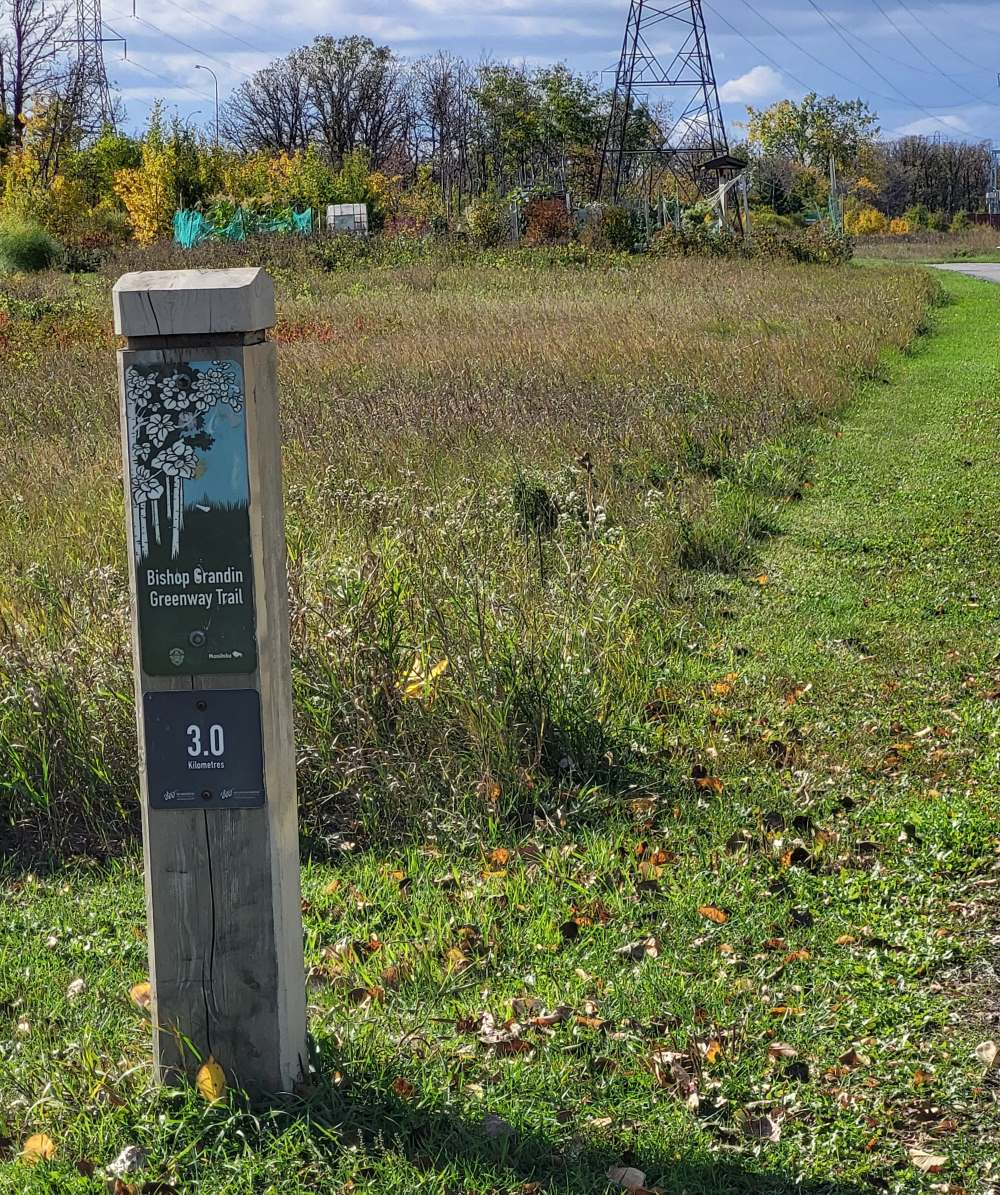
To be clear: Bishop Grandin Greenway is (was) a linear greenspace between the Seine and Red Rivers, and Bishop Grandin Trail refers to the ribbon of concrete that runs along the boulevard between Waverly West and Sage Creek. Bishop Grandin Greenway Inc. was a registered charity that initiated the creation of, but is not responsible for, the active transportation path.
Clear as mud, right? Good.
So anyhow, in an addendum to Reanna’s twitter thread, Danielle went back to the Elders from the Circle and procured us a new name: Awasisak Mēskanôw Greenway. (I spoke to the Winnipeg Free Press Community Review about it HERE.)
The Greenway was now essentially named after the trail it worked with the City of Winnipeg to create.
We had suggested the name Oshkii Greenway — ‘Oshkii’ being part of the original naming recommendation from the elders that was dropped in the final recommendation. It is a Cree word meaning “renewal”. I personally love the concept, the greenway being a renewal of an unused Hydro corridor, and the renaming itself being a renewal of sorts. It is also a catchy name that would work well for an organization like ours that engages with the public.
As an organization, we could name ourselves anything really. But .. the Greenway is on city land and we needed financial help from the City for some of the costlier parts of the renaming. Our intention from the start was to honour the City’s consultations and we did not think it was wise to waiver from that path.
Our organization is now officially Awasisak Meskanow Greenway Inc. (no accents over the e or o — they are not permitted for an incorporated entity in Canada) and the greenspace is now called Awasisak Mēskanôw Greenway. Our website has moved from bishopgrandingreenway.com to awasisakmeskanowgreenway.ca, and our Twitter and Instagram handles have already both been changed to @awasisak.
The renaming ceremony
New Abinojii Mikanah street signs are up, our retaining wall has been changed to say “Awasisak Mēskanôw” (the accent over the o is coming shortly — it was a late addition by the Elders) and new trail signage is being created. There is still work to do, both for us and for the City, but the end of the three year journey is close.
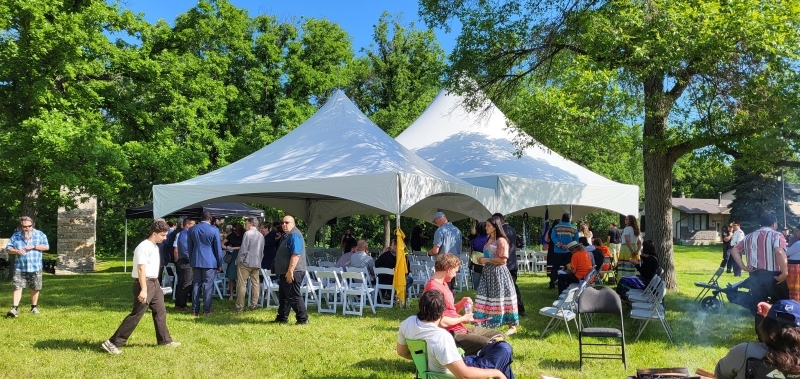
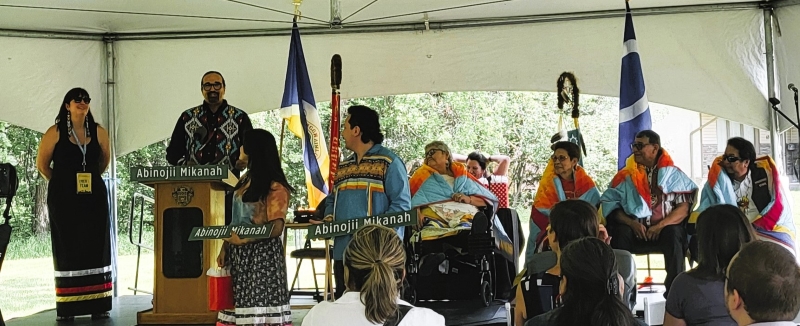
On June 21, National Indigenous Peoples Day, a ceremony was held near the corner of Abinojii Mikanah and River Road, just off the Greenway. It marked the official unveiling of the new names for the boulevard and the trail.
There will be no ceremony specifically for the Greenway, but the invitation to the June 21 event provided some closure. It was a nice (if long, at 3+ hours) ceremony that included performances from Indigenous artists — including remarkable throat singing from Inuit artists Aleatra Sammertok and Lucy Angnakok — and many heartfelt speeches.
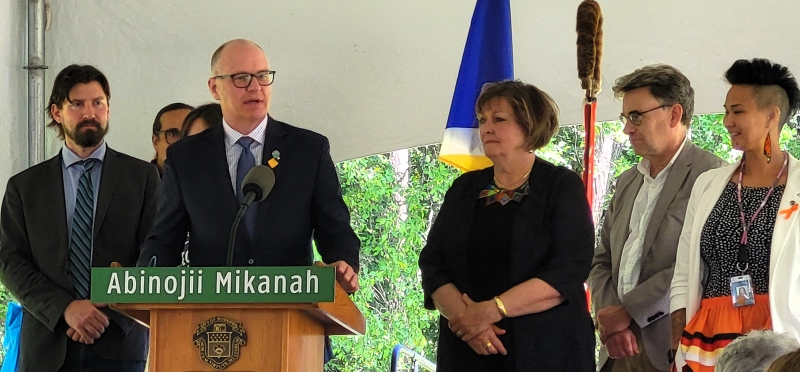
I should mention that Mayor Scott Gillingham comes across as a genuine character. His speech seemed honest and thoughtful, and he was one of very few dignitaries who stayed for the entire event.
So what now? I guess we move on. We on the Greenway team will do greenway things — running a community garden, organizing cleanups, planting trees and so on. Users of the street, greenway and trail will get used to the new names. There is no doubt that the name of the street in particular will be shortened in conversation … even Lagimodière Boulevard is shorted to “Lag” more often than not. Clearly a seven syllable name will be butchered somehow.
But that is what it is. The meaning behind both names, Abinojii Mikanah and Awasisak Mēskanôw, is an important one. Both mean the ‘child’s road/path’ in different languages. The “path” refers to both the physical road and trail, and at the same time, the journey of residential school survivors. They remind us of the reason this renaming process began over three years ago.


 Around This Town
So they have renamed Bishop Grandin because of the terrible person he was, I suppose. I find it ironic that they have not renamed St. Vital. St. Vital and Bishop Grandin were the same person.
A man named Vital Grandin became a bishop. Then he was Bishop Grandin because they use your last name for that. Later, when he was canonized and made into a saint, he was St. Vital because they use your first name for that (St. Thomas, St. Andrew, etc.)
If he was bad (and I am not saying he was, I did not rename anything) then he was bad.
Seems like a lot of meaningless virtue-signalling to me.
Just because it’s meaningless to you, does not imply it’s meaningless to everyone. The renaming means A LOT to many people.
It is definitely the erasing of white European history. The white European people who created Canada are being attacked by racist Indians and spineless, rat parasite careerist politicians. Derick is a racist anti-white punk, who’s article here is a transparent, sick attempt at justifying anti-white racism. You are a revolting coward Derick.
They weren’t the same person. Saint Vital (Vitalis) was Bishop Grandin’s patron saint. He lived in Italy and died in 171 AD.
I love all of this. What a thoughtful and well-done process all around! Congrats on your approach and methodology!
One quick thing of note: when referring to the people, Indigenous should be capitalized. When referring to local flora/fauna, then it’s lower case. Spotting that early on made me think that this article was going to go in a very different direction!
Thank you. Fixed.
impressive! Global Supply Chain Disruptions Continue to Impact Prices 2025 sublime